Prostate cancer is one of the most commonly diagnosed cancers among men worldwide. As patients search for new and alternative treatment options, interest in Fenbendazole and prostate cancer has grown significantly. Fenbendazole, originally developed as a veterinary antiparasitic medication, has gained attention due to anecdotal reports and preliminary laboratory studies suggesting potential anti-cancer properties.
While some individuals claim positive experiences using Fenbendazole alongside conventional cancer treatments, it is important to understand the current scientific evidence, potential benefits, risks, and limitations before considering its use.
In this article, we will explore the relationship between Fenbendazole and prostate cancer, review existing research, discuss how it may work, and answer common questions.
What Is Fenbendazole?
Fenbendazole is a broad-spectrum antiparasitic drug commonly used to treat worms and other parasitic infections in animals, including dogs, cats, horses, and livestock. It belongs to the benzimidazole class of medications and has been widely used in veterinary medicine for decades. How to take fenbendazole for cancer remains uncertain due to limited human research.
The drug works by disrupting microtubule formation in parasites, preventing them from absorbing nutrients and ultimately causing their death. Recently, researchers have become interested in whether this mechanism could also affect cancer cells.
Why Is Fenbendazole Being Discussed for Prostate Cancer?
Interest in Fenbendazole as a possible cancer treatment surged after several cancer patients shared personal stories online claiming improvements while using the drug. Researchers have also conducted laboratory studies suggesting that Fenbendazole may:
- Interfere with cancer cell growth
- Disrupt microtubule function
- Promote cancer cell death (apoptosis)
- Reduce glucose uptake in tumor cells
- Enhance the effects of certain cancer therapies
These findings have led some patients with prostate cancer to explore Fenbendazole as a complementary treatment option. However, it is essential to note that laboratory and animal studies do not automatically prove effectiveness in humans.
Understanding Prostate Cancer
Prostate cancer develops in the prostate gland, which is part of the male reproductive system. It ranges from slow-growing tumors that may never cause symptoms to aggressive cancers that can spread to other parts of the body.
Common Risk Factors
| Risk Factor |
Description |
| Age |
Risk increases significantly after age 50 |
| Family History |
Genetics can play a major role |
| Race |
Some populations have higher incidence rates |
| Obesity |
Associated with more aggressive forms of prostate cancer |
| Lifestyle Factors |
Diet and physical inactivity may contribute to risk |
Common Symptoms
- Frequent urination
- Difficulty starting or stopping urine flow
- Blood in urine
- Pelvic discomfort
- Erectile dysfunction
- Bone pain in advanced stages
Early detection through regular screenings can significantly improve outcomes.
How Might Fenbendazole Work Against Prostate Cancer?
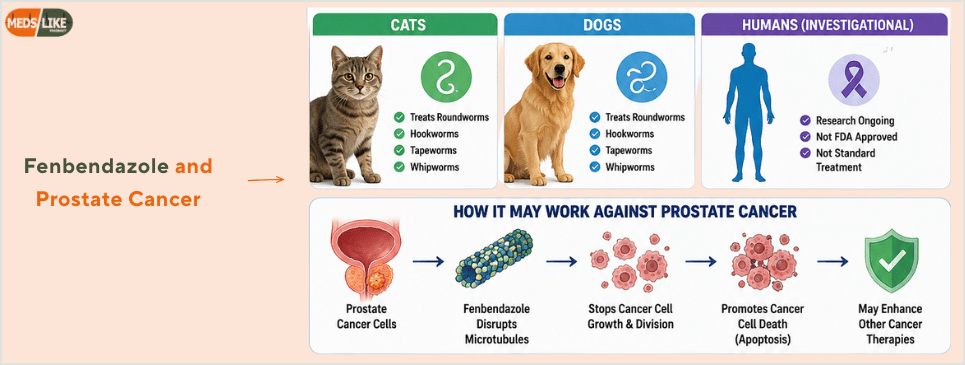 Although research is still ongoing, scientists have proposed several mechanisms through which Fenbendazole may affect cancer cells.
- Disruption of Microtubules
Cancer cells rely on microtubules to divide and multiply. Fenbendazole may interfere with these structures, making it harder for cancer cells to reproduce.
- Induction of Apoptosis
Apoptosis is the body’s natural process of programmed cell death. Some laboratory studies suggest Fenbendazole may trigger apoptosis in certain cancer cell lines.
- Reduced Glucose Utilization
Cancer cells often consume large amounts of glucose for energy. Researchers believe Fenbendazole may interfere with glucose metabolism, potentially starving cancer cells.
- Enhanced Cellular Stress
Fenbendazole may increase oxidative stress within tumor cells, making them more vulnerable to damage and death.
Current Research on Fenbendazole and Prostate Cancer
Scientific interest in Fenbendazole has increased over the past few years, but research remains limited.
Laboratory Studies
Several in vitro studies have demonstrated that Fenbendazole can inhibit the growth of various cancer cell types, including:
- Lung cancer cells
- Colorectal cancer cells
- Ovarian cancer cells
- Prostate cancer cells
Researchers observed reduced cell proliferation and increased cancer cell death under controlled laboratory conditions.
Animal Research
Some animal studies show that fenbendazole produces anti-tumor effects in mice with certain cancers. However, results have been inconsistent across different studies.
Human Clinical Trials
At present, no large-scale clinical trials are proving that Fenbendazole effectively treats prostate cancer in humans. This lack of human evidence remains one of the biggest limitations when evaluating Fenbendazole as a cancer treatment.
Potential Benefits of Fenbendazole for Prostate Cancer
Supporters of Fenbendazole often cite several potential advantages.
Possible Benefits
- Low cost compared to many cancer drugs
- Widely available in veterinary formulations
- Promising laboratory research
- Potential complementary use with conventional therapies
- Ongoing scientific interest
Despite these potential advantages, benefits remain largely theoretical until validated through clinical research.
Risks and Safety Concerns
Using Fenbendazole without medical supervision can present risks.
Possible Side Effects
| Side Effect |
Description |
| Nausea |
Stomach discomfort may occur |
| Diarrhea |
Digestive upset reported by some users |
| Liver Stress |
Potential impact on liver function |
| Headache |
Occasionally reported |
| Fatigue |
Temporary tiredness may occur |
Important Considerations
- Fenbendazole is not approved by major regulatory agencies for treating cancer in humans.
- Product quality may vary depending on the source.
- Interactions with chemotherapy or other medications are not fully understood.
- Self-treatment may delay proven medical care.
Patients should always consult an oncologist before adding any alternative therapy to their treatment plan. Prostate cancer and fenbendazole require more human studies to confirm its potential role in treatment.
Fenbendazole vs Conventional Prostate Cancer Treatments
| Treatment |
Proven Effectiveness |
FDA Approved |
Human Clinical Evidence |
| Surgery |
High |
Yes |
Extensive |
| Radiation Therapy |
High |
Yes |
Extensive |
| Hormone Therapy |
High |
Yes |
Extensive |
| Chemotherapy |
Moderate to High |
Yes |
Extensive |
| Fenbendazole |
Unproven |
No |
Limited |
Conventional treatments remain the standard of care because they have undergone rigorous clinical testing and demonstrated effectiveness in human patients.
Should Prostate Cancer Patients Consider Fenbendazole?
Patients should approach the decision to use fenbendazole with caution. Patients interested in Fenbendazole should:
- Discuss it with their oncologist.
- Continue recommended cancer treatments.
- Monitor liver function and overall health.
- Avoid replacing evidence-based therapies with unproven alternatives.
- Stay informed about emerging research.
Fenbendazole shows intriguing laboratory results, but researchers still need more human studies before recommending it as a standard treatment for prostate cancer.
Future of Fenbendazole Research
Researchers continue investigating whether Fenbendazole and related compounds may have a role in cancer therapy. A fenbendazole dosage calculator provides dosage information, but medical advice is recommended before use. Future studies will focus on:
- Determining effective human dosages
- Evaluating long-term safety
- Understanding drug interactions
- Measuring effectiveness in clinical trials
- Identifying which cancer types may respond best
The coming years may provide clearer answers regarding Fenbendazole’s potential role in prostate cancer management.
Conclusion
The growing interest in Fenbendazole for prostate cancer treatment reflects a broader search for innovative and affordable cancer treatment options. Laboratory and animal studies suggest that Fenbendazole may possess anti-cancer properties, including disrupting cancer cell growth and promoting cell death.
However, current evidence remains insufficient to confirm that Fenbendazole is an effective treatment for prostate cancer in humans. Conventional therapies such as surgery, radiation, hormone therapy, and chemotherapy continue to be the most reliable and scientifically supported treatment options.
FAQs
Q: Can Fenbendazole cure prostate cancer?
No. There is currently no scientific evidence proving that Fenbendazole can cure prostate cancer in humans.
Q: Why are people using Fenbendazole for cancer?
Some patients are interested in Fenbendazole because laboratory studies and anecdotal reports suggest it may have anti-cancer properties.
Q: Is Fenbendazole approved for human cancer treatment?
No. Fenbendazole is not approved by regulatory authorities for treating cancer in humans.
Q: Can Fenbendazole be taken with prostate cancer medications?
Potential interactions are not fully understood. Patients should consult their oncologist before combining Fenbendazole with any cancer treatment.
References:
 +1 305 709 4119 (Click to chat)